

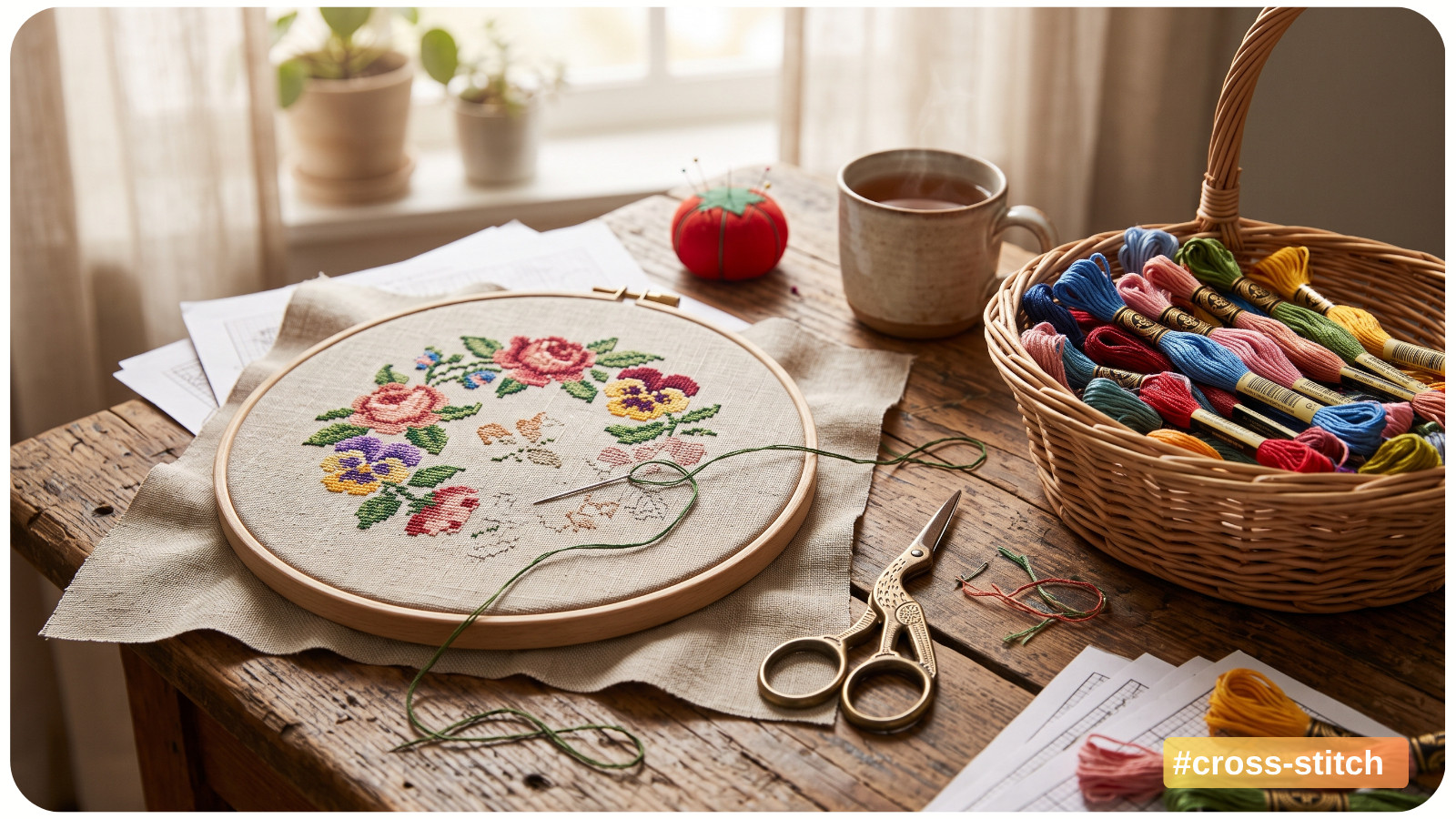
To work out how much floss you need for cross stitch, start with your pattern's thread requirements and calculate each color separately. If it gives only stitch counts, estimate each color separately using the fabric count, number of strands, and stitch type. Account for starts, ends, mistakes, and thread carried across the back, checking which losses the estimate already includes.
There is no single skein count that fits every project. A small design with a solid background can use more thread than a larger outline design. The useful number is how many stitches you will make in each color.
Here is how to turn that information into a shopping list.
How Much Floss Is in a Skein?
DMC Six-Strand Embroidery Floss comes in 8-meter skeins, about 8.7 yards. Each length contains six strands that can be separated.
If you stitch with two strands, you can separate the six into three pairs. Using all three pairs gives you 24 meters of two-strand working length before waste. This is the combined length of the separate working pieces, not one continuous 24-meter thread.
Working Length From One 8-Meter, Six-Strand Skein | |
Strands used together | Combined working length before waste |
|---|---|
1 | 48 meters |
2 | 24 meters |
3 | 16 meters |
6 | 8 meters |
These are length conversions, not stitch counts. Check the label on other threads because skein lengths and strand structures can differ.
Read the Pattern's Floss Requirements First
Look for a materials list, thread key, or floss usage page. It may give whole skeins, fractions of a skein, thread lengths, or stitch counts by color.
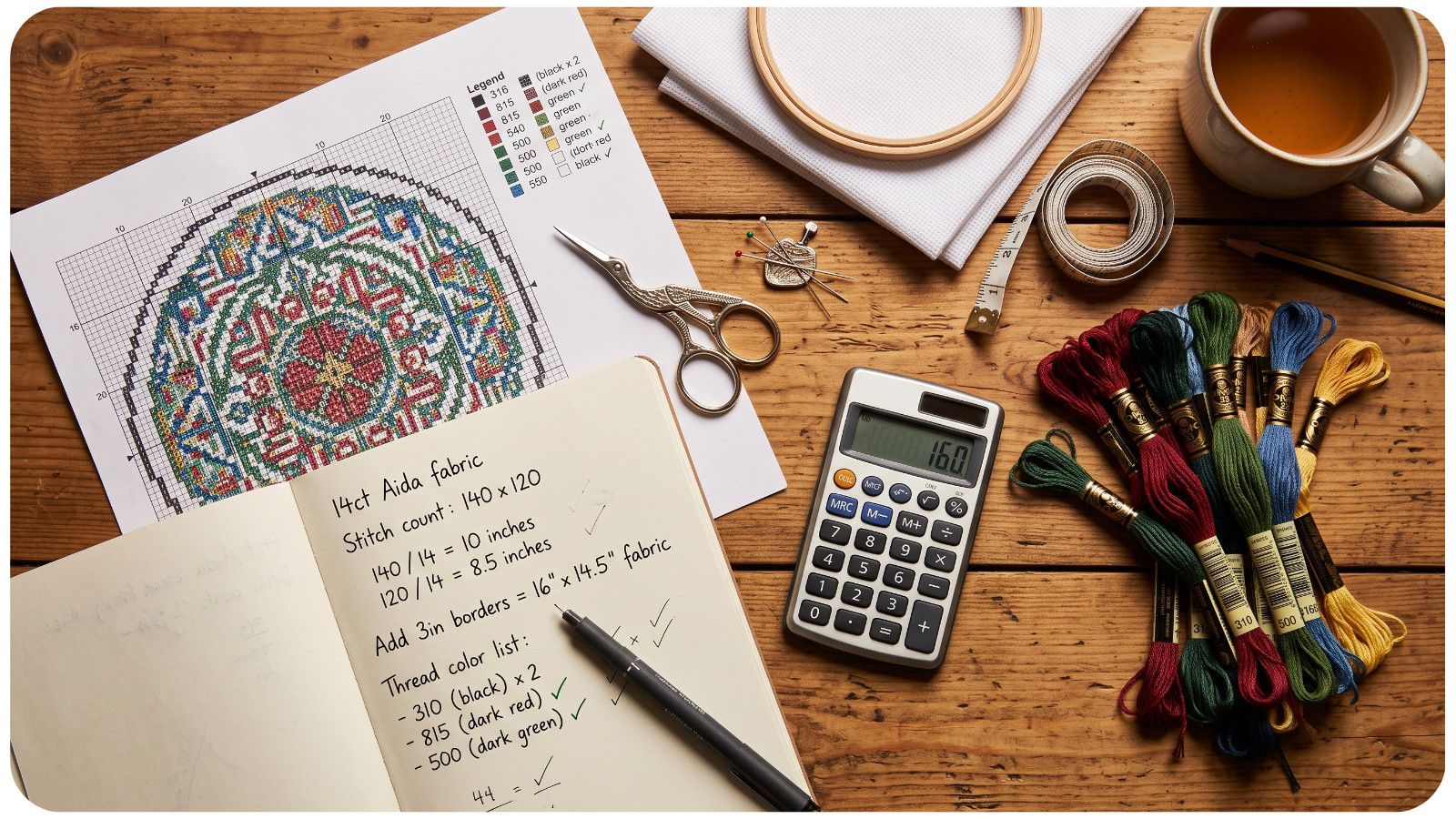
Check which fabric count and strand count the estimate assumes. If you are choosing between formats, remember that a PDF pattern is a chart; check a physical kit's contents before buying extra materials. Requirements for two strands on 18-count Aida will not transfer unchanged to three strands on 14-count Aida.
Also check what a length means. A chart might report six-strand floss length, while another tool reports individual-strand length. Those figures cannot be compared directly. Read the notes or ask the designer before converting meters into skeins.
If the designer already includes an allowance for waste, avoid adding several extra margins without a reason.
What Changes How Much Cross-Stitch Floss You Use?
Fabric Count and Stitch Size
For the same chart and strand count, larger stitches generally need more thread. A design on 14-count Aida uses larger crosses than the same design on 18-count Aida.
On linen or evenweave, account for how many fabric threads each cross spans. Stitching over two on 28-count fabric gives 14 crosses per inch. If a calculator asks for stitches per inch, enter 14. If it has separate fabric-count and over-one/over-two settings, enter 28 and select over two. Our cross-stitch fabric count guide explains the difference.
Number of Strands
Using three strands instead of two requires roughly 50% more individual-strand length for the same stitching path. Actual waste can change too. Follow the pattern's instructions, and test your preferred coverage before buying floss for a large project.
Stitch Placement and Working Habits
A solid block lets you move between nearby stitches. Scattered single stitches, often called confetti, involve more starts, stops, or travel across the back.
Your cut lengths and finishing method also affect waste. The Scarlet Quince calculator guide explains how its estimates depend on working length, stitching style, and travel. Treat calculator results as estimates with assumptions. If tangled or damaged thread is adding to your losses, see why cross-stitch threads keep knotting.
How Many Cross Stitches Can You Make With One Skein?
There is no fixed answer. For a rough guide, a traditional table in the Needlework FAQ gives these approximate figures for two-strand full crosses:
Approximate Full Crosses Using Two Strands: Traditional Model | |
Aida count | Approximate full crosses per skein |
|---|---|
11-count | 1,400 |
14-count | 1,800 |
16-count | 2,000 |
18-count | 2,300 |
These rounded figures come from an older model using an approximately 8.5-yard, six-strand skein and an allowance for securing ends and waste. The source assumes 18-inch cuts and allows 3 inches per cut for securing ends and waste. These are rough planning figures, not measured yields or exact predictions for modern 8-meter skeins.
Scattered stitches, longer carries, and restitching can reduce your yield. For a color that comes close to using a whole skein, check with a sample or the designer's estimate.
How to Calculate Floss for Each Color
Use this simple formula:
Estimated skeins = stitches in one color ÷ estimated stitches per skein
For example, suppose a color has 2,700 full crosses on 14-count Aida, using two strands. With a rough yield of 1,800 stitches per skein:
2,700 ÷ 1,800 = 1.5 skeins
If you have none of that color, buy two skeins. Repeat for every color, subtract any known usable amount you already own, and round each remaining purchase up to a whole skein.
Do not divide the project's total stitches by its number of colors. A design might use one color for half the picture and several others for tiny details.
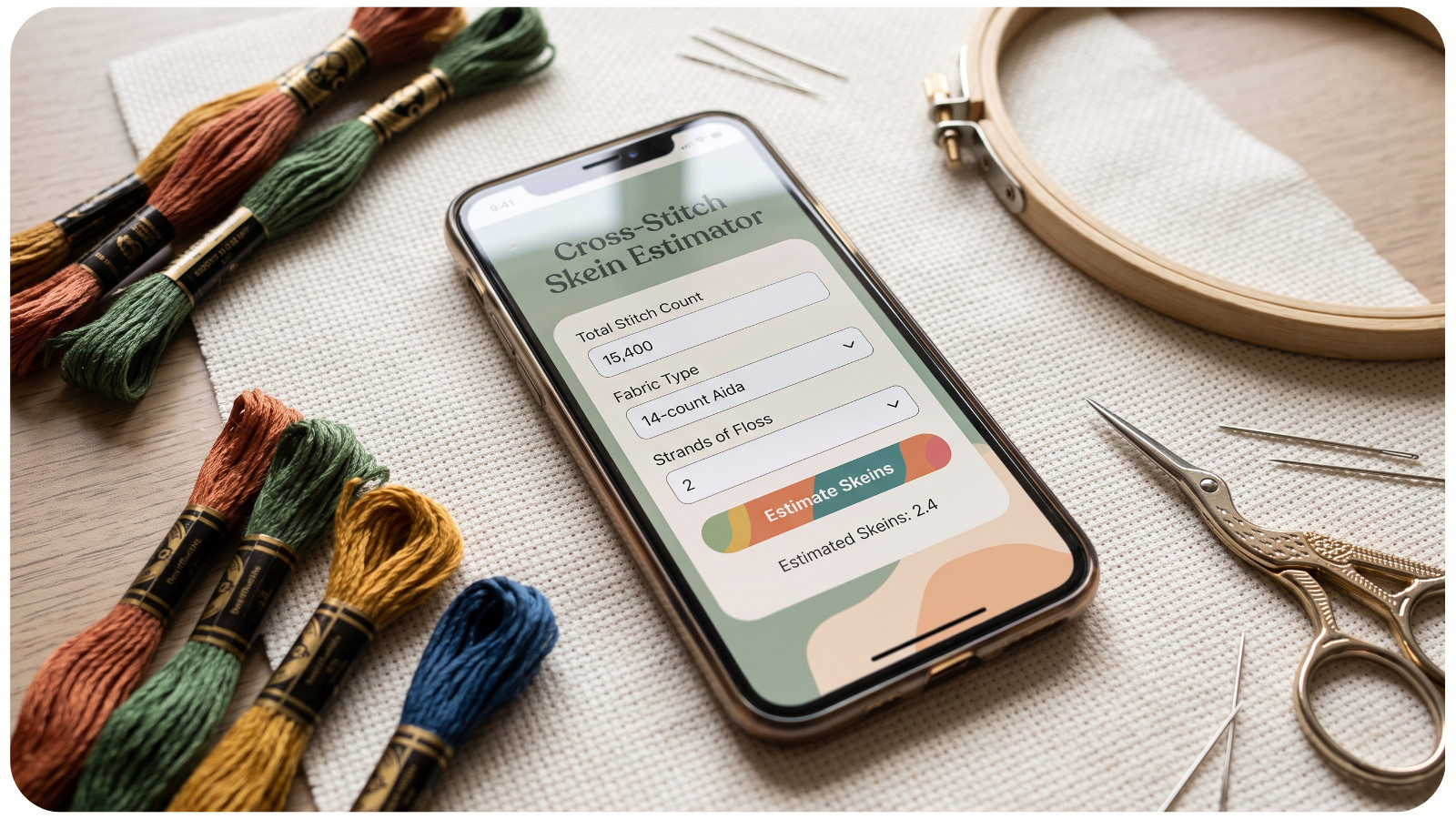
You can also use a cross-stitch skein estimator. Check its skein length, strand count, fabric settings, and waste assumptions before using the result.
Check Your Estimate With a Thread Sample
A sample is especially useful when you change fabric, add strands, or have an almost-empty bobbin.
1. Use a scrap of the project fabric and the intended cotton floss.
2. Cut a measured length, such as 50 cm, and separate the required strands. For this example, use two separate 50 cm strands together, without folding them.
3. Stitch a representative section using your usual starts, ends, and travel distances.
4. Count the full crosses you complete before ending the thread as you normally would. Include your normal starting and ending losses.
5. Repeat with a few measured lengths and use the average. Test scattered areas separately from solid blocks.
For illustration, suppose a two-strand, 50 cm length makes 35 full crosses. This is a hypothetical sample result, not a universal stitch rate.
If all six strands are used as three pairs, one 8-meter skein provides 24 meters of two-strand length:
24 ÷ 0.5 = 48 working lengths
48 × 35 = about 1,680 full crosses per skein
Because the sample includes your normal starting and ending losses, those losses are already reflected in its yield. It still cannot predict every mistake or change in stitch layout.
Does a Loop Start Change the Calculation?
A common two-strand loop start uses one strand folded in half. A 100 cm single strand becomes a 50 cm doubled working length. Record the full single-strand length consumed when comparing methods. Folding creates two working strands; it does not double the amount of thread in the skein.
How Much Extra Floss Should You Buy?
For a self-made estimate, a further 10% to 20% can be a practical planning cushion. This is a buying choice, not a universal allowance or a promise that you will have enough.
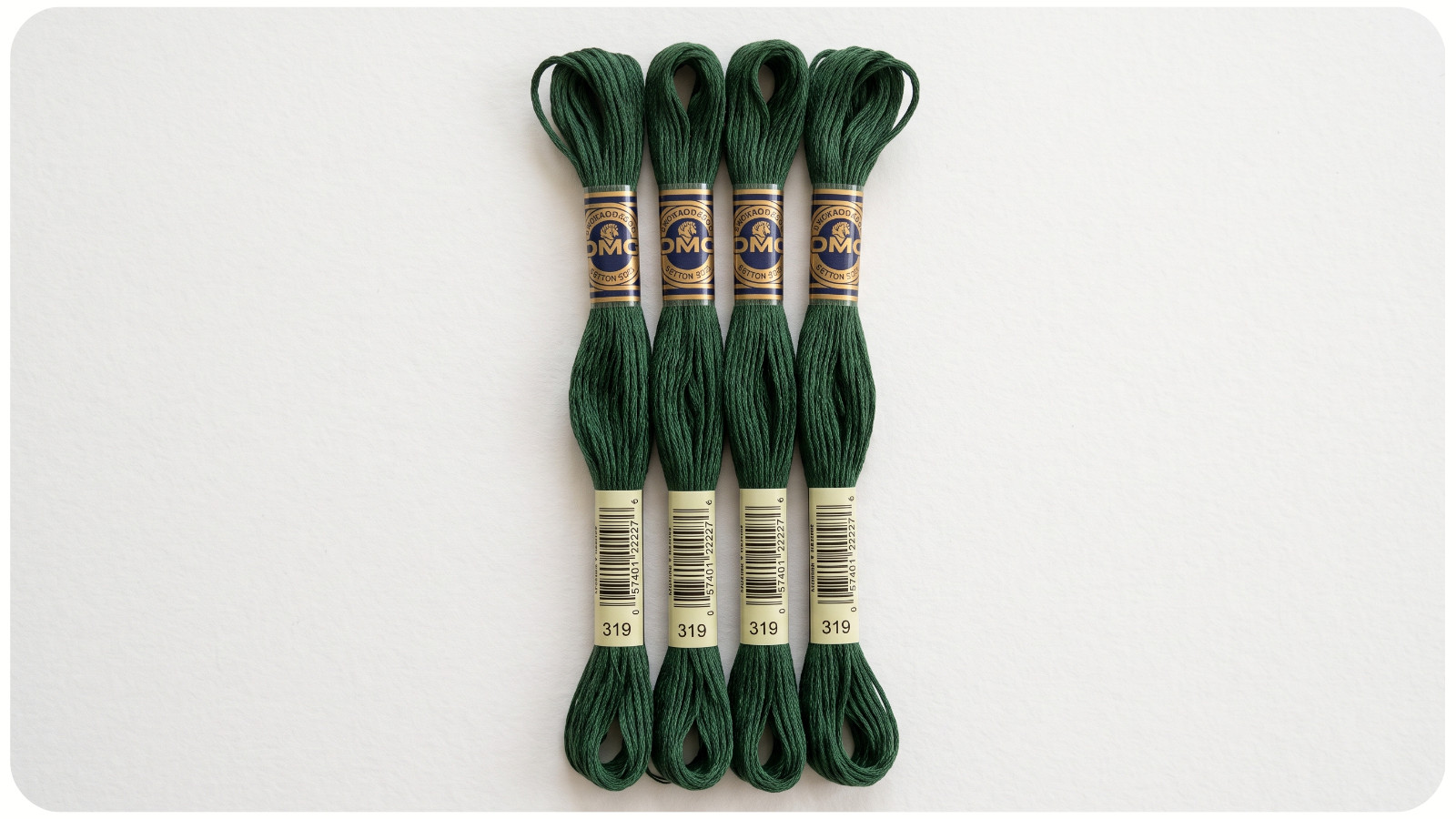
Consider more room when the design has heavy confetti, you expect to undo stitches, or replacing the thread would be difficult. A calculator that already builds in generous waste may need less extra allowance.
Whole-skein rounding often creates a cushion by itself. An estimate of 1.5 skeins becomes a two-skein purchase, leaving half a skein above the estimate. Buying an additional skein of every tiny accent color is rarely necessary.
For a large area, gather enough of the same thread before starting. Compare skeins in good light, and match dye lots where the manufacturer provides them.
Count Backstitch, Blends, and Special Threads Separately
Full-cross estimates do not directly cover backstitch, fractional stitches, or French knots. Follow the chart's separate requirements or test those stitches separately.
For a blend made with one strand of color A and one of color B, charge one strand's usage to each color. Add that to each color's use elsewhere in the design. Do not assign the full two-strand amount to both colors.
Metallic, silk, and other specialty threads need their own estimates. Their pack lengths, strand structures, and working losses may differ from standard stranded cotton.
What If Your Pattern Has No Stitch Counts?
Ask the designer for floss requirements or a stitch-count report. For a small chart, you can count each symbol by color, marking completed sections on a working copy.
Chart width multiplied by height gives the number of grid squares in the design's rectangle. It equals the full-cross total only when every square contains a full cross. Blank background areas should not become thread purchases.
Before shopping, write down each color, its estimated requirement, what you already have, and how many whole skeins you need to buy. Check your cross-stitch fabric size separately so both purchases match the same chart and stitching setup. Keep those threads with the project. That small check makes your estimate useful from the first stitch to the last.