



Look at a piece of Strawberry Thief and your eye may go straight to the birds. Follow the stems for a moment. A flower leads you back into the leaves, then another bird appears. The same group of shapes repeats across the cloth, but you can take a different path through it each time.
William Morris (1834 to 1896) changed pattern design by showing how wallpaper and furnishing fabrics could shape the feel of a room. He arranged familiar plants and birds in repeats that hold together across a wall or a length of cloth and still reward a close look. In Victorian Britain, his designs and writing also helped make the skill behind everyday furnishings a subject of public discussion.
What Made William Morris’s Wallpaper Different?
When Morris began designing wallpaper in the 1860s, British buyers could already choose between papers that used shading to make flowers look three-dimensional and designs that favored flatter, more formal arrangements. Morris shared the design reformers’ interest in patterns suited to a flat wall. His distinctive choice was to give those patterns the irregular rhythms of plants growing around one another. A stem could bend, disappear behind a leaf, and pick up again without making the wall look like a view through a window. V&A on Morris’s wallpaper designs
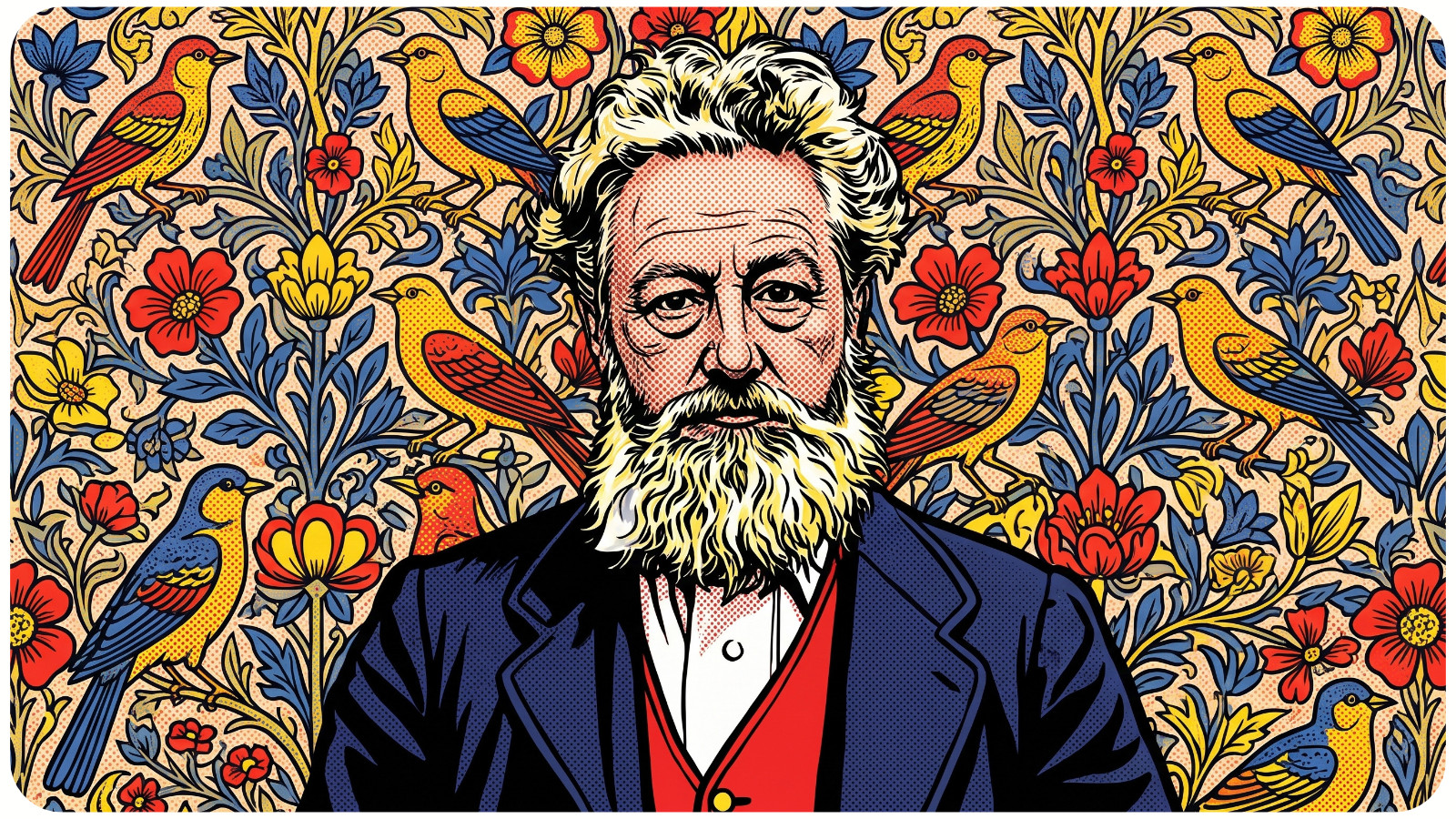
Trellis, his first wallpaper design, makes that idea easy to see. Designed in 1862, it grew out of the rose trellises at Red House in Kent, the home Philip Webb designed for William and Jane Morris. Webb also drew the birds for the wallpaper. The straight bars establish a grid, the roses cross its lines, and the birds interrupt the steady climb of the stems. The design stays easy to read because the bars give the eye something regular to return to. William Morris Gallery’s original design for Trellis
Morris took a quieter approach with Daisy. He designed it in 1862, and it became the first wallpaper his firm issued in 1864. Small groups of meadow flowers sit apart, with a lightly marked background visible between them. The V&A traces the central flower shape to a wall hanging pictured in a fifteenth-century manuscript. The flowers look familiar from a walk in the fields, and their arrangement belongs to an older tradition of decorating rooms. William Morris Gallery’s Daisy wallpaper record · V&A on Morris’s historical sources
That mix of observation and study also shaped Morris’s textiles. For Wandle (1884), he drew on a sixteenth-century Italian velvet. He kept the rhythm of its winding vine and used large chrysanthemum heads in place of crowns. Compare that choice with the way APS’s guide to folk art looks at what changes when a familiar shape appears on a different object.
How the Repeat Works in Acanthus and Strawberry Thief
A pattern repeat is the part of a design that repeats across a surface. When a stem runs off one edge, it can pick up at the matching point on the next copy. A single repeat can look like a small composition on paper, while several repeats together give the surface a rhythm of its own.
In Acanthus, designed in 1874 and registered in 1875, broad leaves curl over and around one another. Start with a pale leaf and follow it to the point where a darker shape crosses it. That overlap pulls your attention deeper into the pattern, and the next curve carries it back out. The leaves themselves do the work that the straight trellis bars did in the earlier wallpaper. The William Morris Gallery records a repeat roughly 26 by 21 inches, large enough for the viewer to follow the broad curves from across a room. William Morris Gallery’s Acanthus wallpaper
In Strawberry Thief, a cotton furnishing fabric whose design was registered in 1883, the birds give your eye a place to pause. Smaller leaves, flowers, and berries lead it toward the next bird. The V&A links the design to thrushes taking fruit from the kitchen garden at Kelmscott Manor. Imagine the fabric hanging as a curtain. A fold could hide one bird while revealing another farther along. William Morris Gallery’s Strawberry Thief cotton · V&A on Morris’s textiles
How Printing and Craft Shaped the Patterns
The crisp details in Strawberry Thief depended on a printing method called indigo discharge. Printers began with blue-dyed cloth and removed the dye in selected areas. Red and yellow were also used in a process that took several days. The method made it possible for small leaves and berries to sit close together and still have clear outlines. For a modern example of how these choices affect a design, see APS’s guide to drawing inspiration from night gardens. V&A on Morris’s textiles · William Morris Gallery’s printing notes
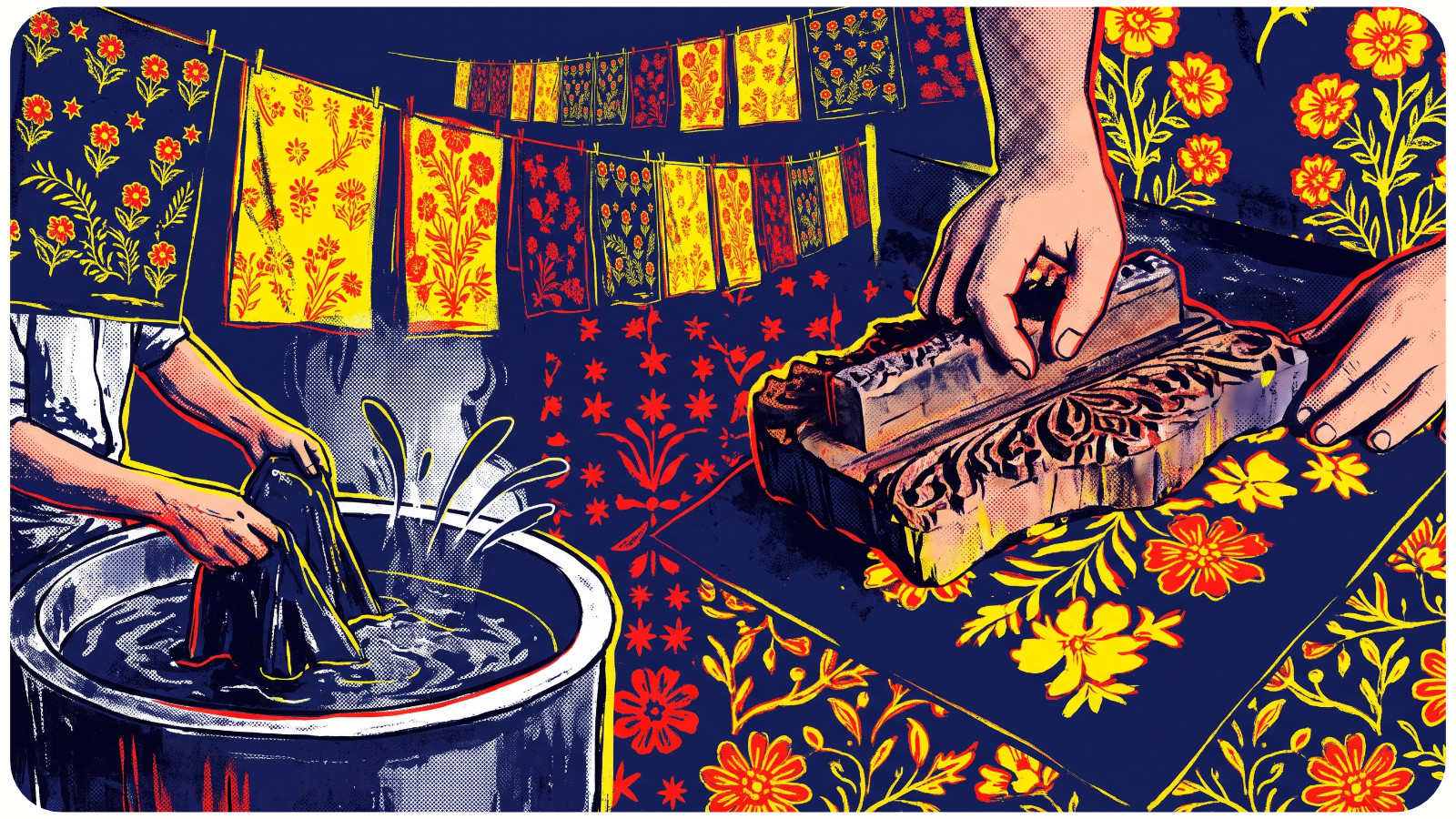
Wallpaper had its own demands. Jeffrey & Co., the printer of Acanthus, needed 30 woodblocks to complete one repeat. Each impression had to line up with the previous ones so the shapes and colors met where the design called for them to meet. A curve that looks effortless on the wall depended on exact work at the printing table. William Morris Gallery’s Acanthus production record
Making a pattern also involved skills that could disappear behind the designer’s name. One Honeysuckle embroidery in the William Morris Gallery is based on William’s 1876 design and was stitched by Jane Morris and their eldest daughter, Jenny. The gallery also holds a Honeysuckle wallpaper designed by their younger daughter, May Morris. The two objects share a name, and their different credits show how much a label such as “Morris design” can leave out. Honeysuckle embroidery · May Morris’s Honeysuckle wallpaper
How Morris Influenced the Arts and Crafts Movement
Morris wanted beauty to belong to everyday life, and he wanted the people making useful objects to have a real stake in their work. In Useful Work versus Useless Toil, he argued that good work should offer enough rest, a result worth making, and pleasure in the work itself. In practice, the care that went into his firm’s goods came at a price. Strawberry Thief was one of its more expensive cottons, even as it became one of its most popular designs. The cost shows how difficult it was to bring time-consuming craft into ordinary homes. Morris’s Useful Work versus Useless Toil
These ideas helped shape Britain’s Arts and Crafts movement, whose designers took the making of everyday objects as seriously as their appearance. Morris’s visual influence can be seen in the work of Charles Voysey. Voysey also arranged plants into flat patterns, often giving his shapes more open space. Voysey kept the interest in natural forms and a flat surface while finding a rhythm of his own. V&A on the Arts and Crafts movement · V&A on pattern design after Morris
The next time you see Strawberry Thief, look at the space between two birds. You can practice the same kind of close looking with APS’s guide to exploring museum collections. That stretch of cloth shows how the repeat guides your eye. The leaves and stems carry your eye across it so naturally that the next bird feels like a small discovery. Morris made that experience part of what a curtain or a wall could offer, day after day.