


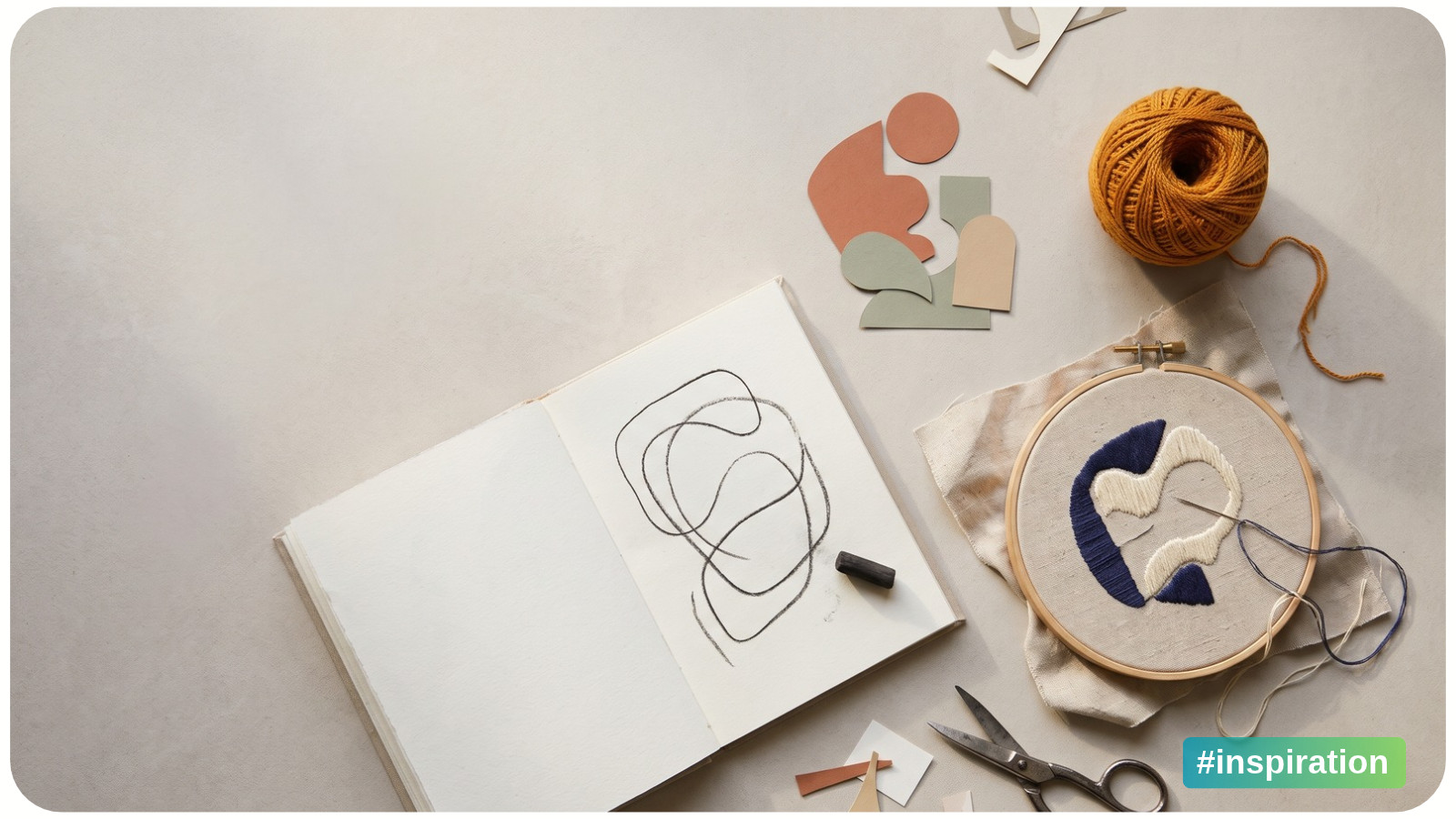
Creative constraints are limits you work within, such as using only two colors, sticking to one shape, or making a design small enough to fit on a patch. A well-chosen limit can make it easier to start and push you past a familiar idea. It gives you one decision to work from while leaving the rest open to play.
Imagine reaching for green thread to embroider a garden and finding only navy and cream. Try navy for the stems, cream for the seed heads, and bare cloth for the spaces between them. Suddenly, the garden looks like something you’d see just after dark.
Why Limits Can Make You More Creative
A useful creative constraint leaves you with a choice you can act on. You might fix the shape and vary the arrangement, or keep the thread color and change how you place the stitches.

They Give You a First Move
“Make something with these fabric scraps” still leaves a lot to decide. “Make a picture using only triangles” gives you a first move. Cut a few paper triangles to stand in for the fabric and push them around. Point them up and they look like rooftops. Turn them sideways and they start to look like a school of fish.
They Help You Try a Different Technique
Say you usually use a darker thread to give a stitched leaf depth. With one shade, try placing the stitches close together near the stem and farther apart toward the edge. More cloth shows through between the stitches, so the leaf can look lighter there even though the thread color stays the same.
They Make Small Changes Easier to See
Make three paper houses from the same two colors. Give the first house a dark roof. Put the dark paper in the doorway of the second and along one side of the third. Set them side by side and notice where your eye goes first. One patch of color can shift the focus of the whole picture.
What the Research Says About Creative Constraints
In two experiments, Catrinel Haught-Tromp asked college students to write two-line greeting-card rhymes. For some rhymes, students had to include a specific noun. The word was assigned in one experiment and chosen by the students in the other. Independent judges rated the rhymes with a required word as more creative in both experiments. Read the study on constraints and creative writing.
Adam Damadzic and colleagues analyzed 111 studies and found a positive link between constraints and creativity overall. The strength of that link varied across studies, including with the kind of limit, the study design, and how creativity was measured. Read the analysis of constraints and creative performance.
For a craft project, the greeting-card experiment suggests a prompt you can try at home. Pick one element that has to appear, like a scrap of striped paper, and see how many different roles it can play.
Four Creative Constraints to Try in Your Next Craft Project
Start with the decision that’s slowing you down. These examples each put a limit on one choice and give you something small to make or compare.
• Limit your palette to two colors. Embroider a stem in rust and use pale pink for the petals. Leave a little bare cloth between the petals to see how the background shapes the flower.
• Give one bold scrap a job. Use a piece of a blue-striped envelope in a paper collage. Turn it sideways and it could become a shop awning. Cut it into strips and it could become window blinds.
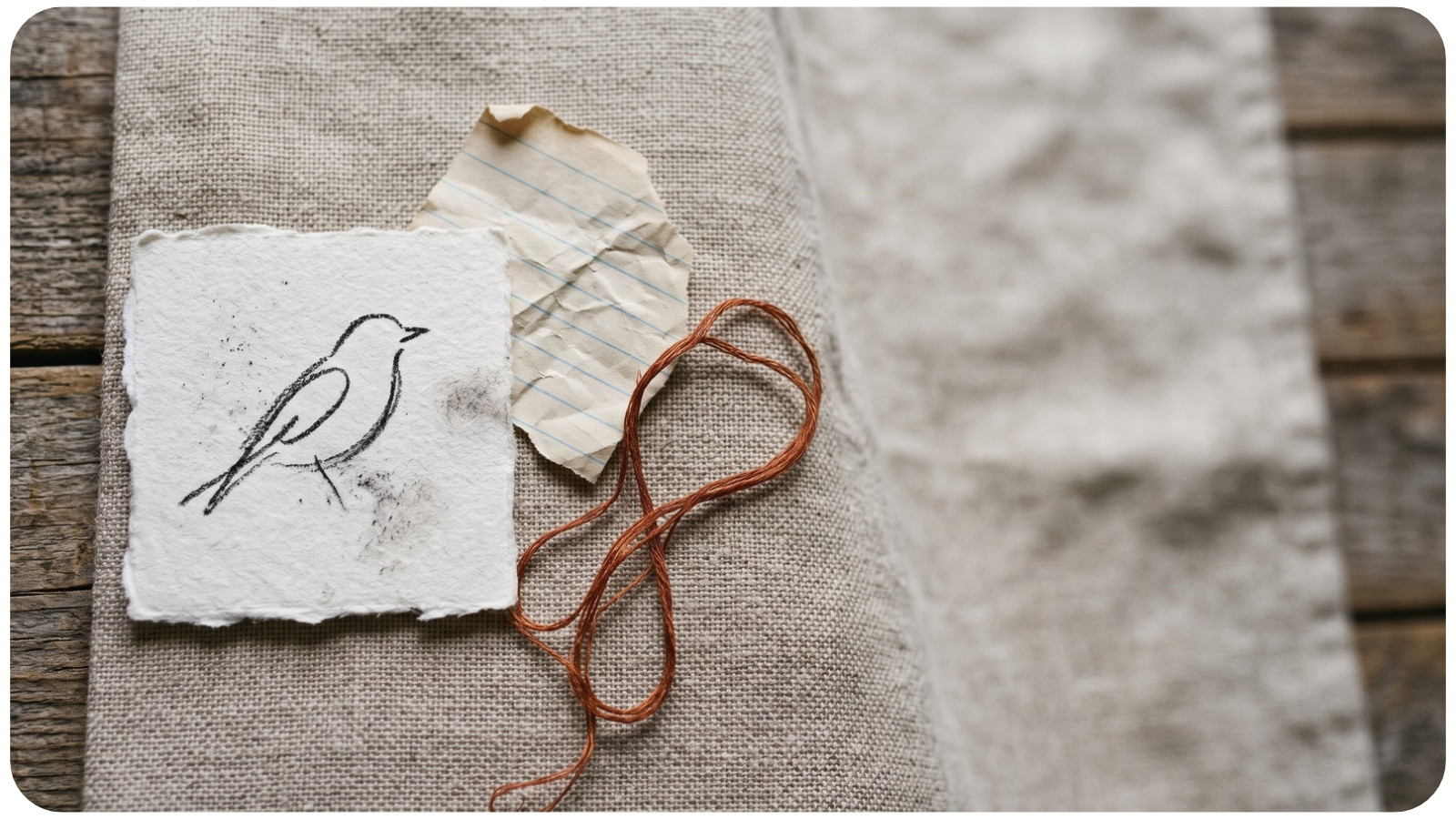
• Work inside a two-inch square. Sketch a bird in profile. Keep the angle of the beak and the curve of the belly. See how much of the wing you can suggest with a single line.
• Stick to one familiar stitch. Make two small swatches with the same yarn, hook, and stitch count. After the first row, work each single crochet through both loops on one swatch and through the back loop only on the other. Compare the textures.
You can also set yourself a rule based on a picture. Borrow only the shape of a window or the spacing between a row of trees. For more ways to choose a single detail, see how to find craft inspiration in museum collections.
When a Creative Constraint Gets in the Way
Two colors can be a fun rule for a swatch. Add an unfamiliar stitch and a tight deadline for a finished gift, and you might spend the evening watching the clock.
C. Page Moreau and Darren W. Dahl tested both limits in a task where people designed a toy. When participants had to use a fixed set of parts, those with a five-minute deadline showed less evidence of looking for new ways to use those parts than those given up to 50 minutes. Read the study on available parts and time limits.
If every shade in your chosen palette blends into the background, swap one for a lighter or darker color. If time is tight, sketch a corner of the design or stitch one repeat and save the rest for later. If you’d prefer a chart you can pick up in short bursts, explore these small cross-stitch projects suited to short sessions.
A Creative Exercise With One Shape and Three Sketches
Draw three small boxes on scrap paper. Use a circle in each one and give it a different job. A few pencil lines are enough to see which idea you want to explore.
1. Make it the subject. Draw one large circle near the edge of the first box. Add a low horizon and it becomes a rising moon.
2. Make it a pattern. Fill the next box with small circles. Crowd them near the bottom and spread them out as they rise. They might look like bubbles in a pond.
3. Make it an opening. Draw a circle in the last box and fill the space around it with short lines. Leave the center blank. It could be a clearing or a gap between clouds.
Pick the sketch you’d like to see in a different material. The bubbles might become beads on a fabric bookmark. The clearing might be a bare patch in an embroidered field. If you like the moon, move it partly out of the frame and see what the scene feels like with only a sliver showing.
The next time a material is missing, try a small sketch with what you have. The navy thread on the table might be the reason you end up stitching a garden after dark. If that idea makes you want to pick up a needle, explore more craft ideas inspired by night gardens.